My graduate advisor said on numerous occasions that he was an analog man living in a digital world. I have been trying to figure out a way to upload videos into this blog, and I finally made the decision to upload the videos into YouTube and then link to there. So, finally, without further ado, below are two video links. The first is of my favorite Antarctic bird, the sheathbill, and the 2nd is a short video of a Wilson's Storm Petrel feeding at the outfall of Palmer Station. You can use your imagination as to what he may be eating....
Sheathbill video: http://youtu.be/nWgwLII_FXo
Wilson's Storm Petrel video: http://youtu.be/Vq43Am4HlBI
Hopefully, the links work...
Friday, May 10, 2013

Saturday, May 4, 2013
Guess what my favorite Antarctic bird is....
You probably guessed penguin, right? Well, you are wrong! My favorite bird here at Palmer is not Adelie, gentoo, or chinstrap penguin. It's not the giant petrel (shown below)....
Or the cape petrel or Wilson's storm petrel (photos and videos coming soon).
My favorite bird is the snowy sheathbill (Chionis albus), which is supposed to Antarctica's only land bird. They eat really anything they can find. Many people call this bird the Antarctic chicken, and as you can see from the phot, they kind of look like a chicken. Here at Palmer they can be found wandering around the station.
 |
| Young giant petrel. I took this photo at dawn when we were leaving to go fishing, so it's a bit dark. |
 |
| Sheathbill at Palmer Station |
Wednesday, May 1, 2013
Back from fishing...
I went out on the boat fishing and was unable to post any updates from the ship. I will hopefully over the next few days put many new posts.
 |
| Me with a Dissostichus mawsoni. The common name of this fish is the Antarctic toothfish. This is a young one; they can up to ~80kg, but this one was a mere 4.5kg. |
Wednesday, April 24, 2013
Getting ready to leave Chile
 |
| Warehouse in Punta Arenas where we get our gear |
 |
| Lots of options for Palmer Station attire |
 |
| Ooh-la-la... Kristin O'Brien checking out the latest in Palmer Station fashion. |
 |
| Checking out our clothing |
The research vessel that we use is the Laurence M.Gould (or LMG) , which is named after the explorer Laurence McKinley Gould who was a member of Admiral Byrd's expedition to Antarctica in the late 1920s. The boat was built in 1997 by the Edison Chouest Offshore out of Louisiana, and it replaced the Polar Duke. During my 1997 field season I was on the Polar Duke, so I have been lucky enough to be on both vessels. The LMG is about 230 feet in length and quite comfortable (if you are fortunate enough not to get seasick!). Pictures will be coming... so stay tuned.
 |
| Johanne Lewis and Amanda Reynolds walking along dock to LMG |
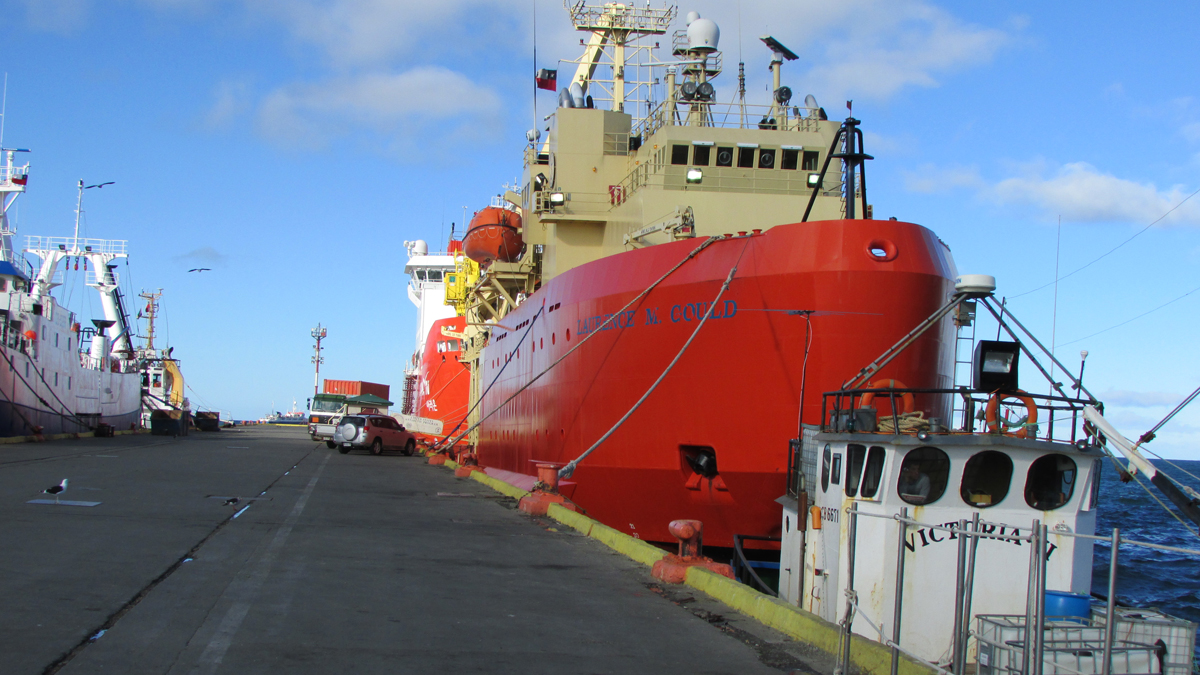 |
| LMG |
Sunday, April 21, 2013
Skipping ahead to Antarctica...
 I still have a lot of pictures and information to post about the ship and traveling down to Palmer Station, but tonight I'm going to show some photos that I took on our walk up the glacier. Behind Palmer Station is a glacier that you can hike up, as long as you stay within the flagged area. Outside the flags are crevasses, which you really don't want to fall into. To walk up the glacier you sign out on a board in the main hallway with the people who are going, where you are going, time out and the time you expect to get back, and you take a radio with you. Anyway, Kristin, Lisa and I hiked up the glacier, which takes about an hour to walk up, and it's icy so we put Kahtoola microspikes that stretch over your boots and keep your from slipping on the ice, after all we are walking on a glacier. Here's a top view of my feet, showing the microspikes on my boots, but it's not that good of picture.
It was a gorgeous sunny day and the temperature was probably around 20-25 degrees Fahrenheit (although I could be off), cold, but not super cold. Below is a photo of Palmer Station I took when I was near the top of the glacier.
 |
| Can you find Palmer Station? |
And on that note, here are some photos from today.


Rubbing the toe for good seas!
 |
| Main square in Punta Arenas. |
 |
| Walking to the square. |
 |
| Large tree |
In the square is a monument to Ferdinand Magellan, the explorer after whom the Strait of Magellan is named. Legend has it that if you rub to toe of the native you will have smooth seas, and when you cross the Drake Passage you need all the help you can get! Rubbing the toe may also give you good luck, or ensure that you will return to Punta Arenas. We rubbed the toe every time we walked through the square!
 |
| Rubbing the toe for a smooth crossing! |
 |
| A closeup of the native's foot---- it's SHINY from all the rubbing! |
 |
| Here's the entire monument with Magellan on the top. |
Shackleton Bar

In the hotel in Punta Arenas there is the Shackleton Bar, obviously named after Ernest Shackleton, an Antarctic explorer. Although he was not the first explorer to reach the South Pole (that honor goes to Roald Amundsen), he set out to cross the entire continent through the South Pole. His ship the Endurance became trapped in pack ice and eventually sunk, so he did not complete he goal, but the story of he and men surviving and being rescued is an amazing story. Anyway, this bar in Hotel Jose Nogueira is a nice place to relax. There's intricate woodwork and paintings that depict Shackleton's expedition, and here we enjoyed pisco sours. The image below does not do the bar justice.

Subscribe to:
Posts (Atom)