The Laurence M. Gould (or LMG) is named after the geologist and explorer Laurence McKinley Gould who was a member of Richard E. Byrd's first Antarctic expedition where he was the second in command under Admiral Byrd. This is the vessel we take from Punta Arenas, Chile to Palmer Station Antarctica.
The Drake Passage is the body of water between South American and South Shetland Islands, which are just off the tip of the Antarctic Peninsula. After the Drake Passage formed about 40 million years ago, it enabled the Antarctic Circumpolar Current to flow around Antarctica with no interruptions, which helped cool the waters around Antarctica. The Drake Passage is known to have the roughest seas in the world. This time down to Palmer Station it was like sailing on a pond however with no storms and the waves were large and rolling.
Anyway, here are some photos of areas inside the boat.
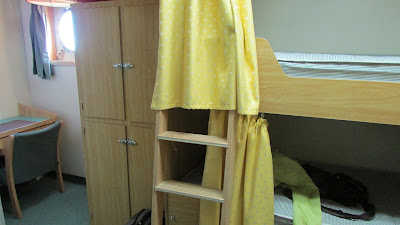 |
| Bedroom with bunkbeds. There are curtains that can be drawn so that you aren't bothered by your bunkmate. Also, note the brown mat on the desk. It keeps computers, books, etc from sliding off. I was lucky to not have a roommate on the way down to Palmer Station from Chile. |
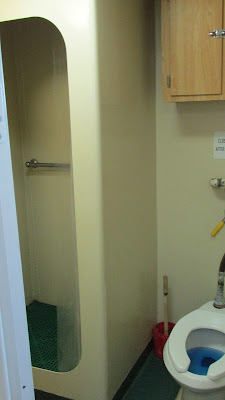 |
| Each room has it's own bathroom with toilet, shower and sink (not shown). You step into the shower, which keeps the water from running out during high seas. The bar in the shower helps you stabilize yourself during the rolling motions of the boat. |
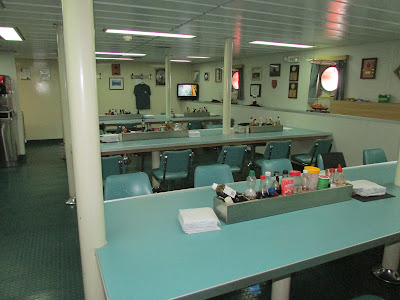 |
| This is the galley where we eat. Notice the condiments sitting on the table in a stationary bin. It keeps things from sliding off the table. Also, the bin holds your glass so that you don't spill your drinks when the boat is moving. |
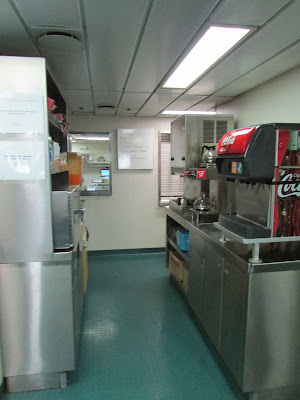 |
| This is another part of the galley that leads to the window where we pick up our food, which in this picture has the metal window closed. It's cafeteria style so you help yourself to the food at mealtimes. The window that is open is where we put our dirty dishes. |
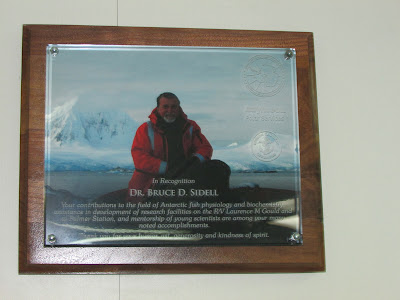 |
| In the galley there is a plaque dedicated to my graduate advisor, Bruce Sidell. He passed away in 2011 way too soon. |
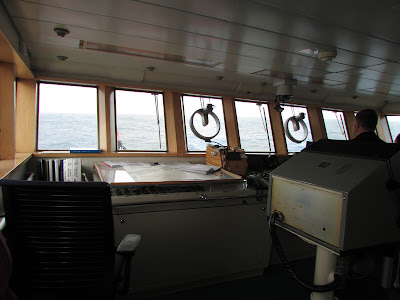 |
| This is the Bridge where the captain (sitting to the right) steers the boat. We can go on the bridge at almost any time and talk to the captain. |
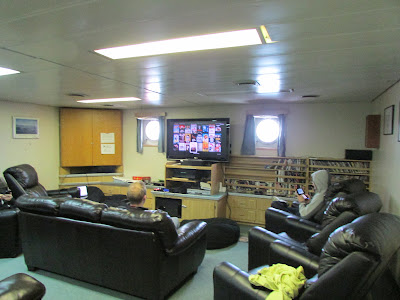 |
| And, of course there is the lounge with comfortable chairs. There is a large selection of movies to keep people occupied on the crossing. It's also a nice place to read a book. |
 |
| We have a meeting when we first get on the boat about what happens if we have to abandon ship and they show us where the life rafts are and all of the equipment and supplies in the life rafts. |
 |
| This is a view of the LMG from the front. The orange circular "thing" on the upper right of the ship (your left) is a life boat. It is a fully enclosed lifeboat, although there is a hatch at the top. Inside there are seat belts that go around your chest and strap you in. In the event of abandon ship in rough seas the lifeboat will roll around and although it will upright itself you need to be strapped to prevent injury to yourself and others. Everyone gets a seasickness bag once they enter the lifeboat, and everyone has to take seasickness meds; even if you don't normally get seasick, the crew said that in one of these lifeboats EVERYONE gets seasick! |
You can read more about the specifics of this boat at NSF's website:
http://www.usap.gov/usapgov/vesselScienceAndOperations/index.cfm?m=4


